I was shocked when I discovered this about my business.
If you run or are involved in a business, I have a true story for you.
It is about how AI can get some of the most basic facts about your business completely wrong – and what that could mean when potential customers are asking AI assistants about businesses like yours.
Let me explain what happened to me.
First, I need to quickly tell you a little about my background so that everything makes sense.
I had a disability and found that I was no longer able to do the work I had previously done.
My disability brought extra expenses, financial problems and a lot of uncertainty about what I could realistically do in the future.
Because of some of the struggles I experienced, I decided to create a website providing guidance for other people with disabilities who might also be looking for ways to earn some additional income.
People with disabilities don’t always have the same mobility as everyone else. Some experience flare-ups in their condition. That can make traditional work difficult.
I wanted to provide useful information and ideas for people who might find themselves in similar circumstances.
I created the website and one very low-cost digital course.
The course was £4.97.
That was the only thing I had for sale.
Once I had completed the website and course, I began looking at ways of promoting it.
Then one day, almost by accident, I thought:
“I’m going to ask ChatGPT what it knows about my business.”
I was aghast at what I found.
I provide the first lesson of my £4.97 course completely free, with no further obligation.
ChatGPT was telling me there was no free lesson.
That was wrong.
But what came next was even more alarming.
I had another completely free resource on the website called:
“Disability Benefits UK and The £20 Test.”
The page explained:
“I am providing access to the £20 Test – free of charge.”
It also included a valuable ready-to-use AI prompt that could be used with any free AI account.
The £20 referred to a strategy for testing a business idea with £20.
It wasn’t the price.
The resource itself was completely free.
Yet the AI was reporting that the resource cost £20.
Worse still, it was saying there was a recurring charge of £20 per month.
There was no £20 charge.
There was certainly no £20 monthly subscription.
It was a complete misunderstanding of what I was offering.
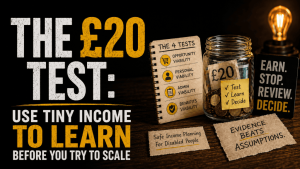
(This was the offer on my page with confirmation this was a free resource)

And at first, I blamed myself.
I thought my explanation must not have been clear enough.
After all the work I had put into the website and the resources, I felt really downhearted.
It genuinely felt like a punch in the gut.
The blow was significant enough that I stopped working on the website and stopped promoting it.
I kept asking myself:
What had I done wrong?
I went back and read the page again.
And again.
I checked the wording.
I checked the offer.
I checked whether I had somehow created ambiguity without realising it.
Eventually, I asked a friend to read the page.
I didn’t tell him what ChatGPT had said. I simply asked him to tell me what he thought was being offered.
His view was straightforward.
The page made sense.
The resource was free.
The £20 referred to the testing strategy.
There was no £20 charge and certainly no monthly payment.
That was when my thinking changed.
If another person could understand it clearly, perhaps the bigger problem wasn’t my page.
Perhaps it was the way the AI assistant was interpreting the information.
And that led me to a much more worrying question:
“If AI had got this wrong, what else might it have got wrong?”
Mine happened to involve a £4.97 digital course and a free resource.
“But imagine the same misunderstanding involving a business where one new customer might be worth hundreds or thousands of pounds.”
Imagine a dentist actually provides dental implants, but an AI assistant tells a potential patient that they don’t.
Imagine a solicitor provides commercial property services, but AI says they don’t.
Imagine someone asks an AI assistant to recommend a local specialist, tradesperson or professional service and your business isn’t included – while a competitor is.
Now the misunderstanding suddenly becomes a lot more expensive.
That was when I started thinking beyond my own website.
My research showed that people were increasingly asking AI assistants to help them research businesses, products and services.
Instead of visiting numerous websites themselves, they could ask questions such as:
Who would you recommend?
Who is the best emergency plumber near me?
Which solicitor should I speak to?
Which of these products should I choose?
The AI assistant can do much of the research and then present an answer.
And that raised a problem I had never previously considered.
I didn’t know what AI was saying about my business.
“The real problem wasn’t simply the mistake. The real problem was that I couldn’t see it happening.”
There was a blind spot.
AI could potentially influence what someone believed about my business and which businesses they considered – while I had virtually no visibility into what was going on.
If I had not happened to ask ChatGPT that question, I might never have known.
I began calling it:
The AI Recommendation Blind Spot.
My previous career had been in IT before my disability changed what I was able to do.
So I made a decision.
I was going to bring myself back up to speed and find out whether there was some way of solving this.
I wanted to be able to see what the main AI assistants were actually saying about a business and compare those answers against the true business facts.
I wanted evidence rather than assumptions.
That was when the idea that eventually became Know Your AI Visibility started to take shape.
But the project almost failed.
I couldn’t see an economical way of repeatedly questioning the major AI assistants, examining their answers, identifying what sources they were using and turning all of that into useful information.
I had become really excited about the potential of the idea.
Then I hit a wall.
For a while, I thought that might be the end of it.
Then, by chance, I met up with an old friend from my IT days.
He asked what I had been doing and I explained the problem and where I had become stuck.
He suggested a different way of connecting the various AI services so I could query them in a much more practical way.
I immediately had one of those light-bulb moments.
I couldn’t wait to get home and test it.
I put everything in place and eventually came to the moment of truth.
I ran my first enquiry across four of the main AI assistants:
ChatGPT. Claude. Perplexity. Google Gemini.
And the results came back.
There they were.
Sitting in front of me in a dashboard.
For the first time, I wasn’t manually asking one AI assistant a question and hoping I had learned something useful.
I could actually see what several AI assistants were saying.
I could compare the answers.
I could see where the business was mentioned and where it wasn’t.
I could compare what AI said against the facts I knew to be true.
What had previously been invisible was now sitting in front of me.
That was the breakthrough.
From there I continued testing.
I could begin to see which businesses AI was putting forward as competitors.
I could identify information that appeared incorrect or wasn’t supported by the facts I had provided.
I could see important questions potential customers were asking and where the website might be missing the information needed to answer them.
And, importantly, I could see what could potentially be improved and then monitor whether those changes made a difference.
That changed the way I thought about the whole problem.
Before this happened, I had assumed that if I put accurate information on a website and explained an offer clearly, that was largely the end of the matter.
“Now I don’t assume. I check.”
When I make a change to the business or add something new, I no longer have to simply wonder whether AI has understood it.
I can go back, look at the evidence and see whether the picture has changed.
I can see what AI actually says.
I can see what it appears to believe about the business.
I can see who it recommends and who it puts forward instead.
And if something looks wrong, unsupported or the business is being overlooked, I can investigate why and what might be improved.
That is why I created Know Your AI Visibility.
The whole experience taught me something I now believe very strongly:
“Any system capable of influencing what customers believe and which businesses they consider should be measured, not guessed at.”
Because the most worrying part of my experience wasn’t simply that AI got something wrong.
It was that, until I happened to ask the question, I had no idea it was happening.
And that is the question I would now ask any business owner:
“Do you actually know what AI is saying about your business?”
Not what you think it should be saying.
Not simply what your website says.
What is AI actually saying when potential customers ask questions about businesses like yours?
Because if you don’t know, you may have exactly the same blind spot that I had.
The difference is that today there is a way to look.
Check My AI Visibility
Start by checking your own AI visibility.
Get Your Free Scan Here
KnowYourAIVisibility.com
In six months time you will be more than thankful that you came across ‘Know Your AI Visibility’.
Because without it, your business would be lacking the ability to see ‘The AI Recommendation Blind Spot’.
That would put you in a totally different place.
“Multiply six months of compounded blind spots.”
Stephen Wilk
Know Your AI Visibility